Choosing a farmhouse sink? Compare fine fireclay and granite-stone surfaces, care, durability, weight, cabinet support, colours and included components to find the right fit for your kitchen.
If you have already fallen for the look of a farmhouse sink, choosing the material is often the next big decision. Fireclay and granite-stone both give you that beautiful apron-front shape, but they feel quite different in a kitchen and need slightly different care.
Fireclay is a natural place to start if you love the smooth, glazed look of a classic white butler sink. Granite-stone may suit you better if you prefer a stone-like finish or want a choice of black, grey, beige or white. There is no single winner for every home. The right choice comes down to the look you enjoy, the marks you are comfortable maintaining and the specifications of the exact sink.

The short answer
- Fine fireclay: kiln-fired clay with a glazed surface; Ezymall's current farmhouse models are Snova White and include single- and double-bowl options.
- Granite-stone: Ezymall's current Laveo Komodo farmhouse models, offered in beige, grey, white and black.
- Everyday care: both are manageable when spills and residue are cleaned promptly using products approved for the sink.
- Durability: both are made for kitchen use, although neither is immune to scratches, stains, chips or marks.
- Installation: both can be heavy, so your cabinetmaker needs the dimensions, weight and support instructions for the exact model.
Fireclay and granite-stone farmhouse sinks compared
| Feature | Fine fireclay farmhouse sink | Granite-stone farmhouse sink |
|---|---|---|
| Surface character | Smooth glazed surface | Stone-like surface; exact texture and formulation are model-specific |
| Ezymall colours | Snova White | Beige, grey, white and black in the current Laveo Komodo farmhouse range |
| Visual direction | Strong association with farmhouse, Hamptons, coastal and traditional kitchens; can also create contrast in modern rooms | Often suits contemporary, monochrome, warm-neutral and material-led kitchens |
| Marks you may notice | Food residue, dark marks or metal transfer can contrast with white glaze | Pale mineral or soap residue may be conspicuous on dark colours; coloured food may mark a poorly maintained light surface |
| Impact and scratching | Durable glaze, but a hard impact or sharp object can chip, crack, scratch or mark it | Designed for kitchen use, but abrasives, sharp objects and severe impacts should still be avoided |
| Weight and support | Substantial; confirm the exact product weight and support method | Also substantial; confirm the exact product weight and support method |
| Best deciding factor | Preference for glazed white fireclay and available bowl sizes | Preference for colour, stone-like appearance and the Komodo model's specifications |
The table is a useful starting point, but material names do not tell the whole story. This comparison relates to the current Ezymall farmhouse sink collection; products sold elsewhere as “fireclay”, “granite”, “stone” or “composite” may be made differently.
What is a fireclay farmhouse sink?
Fireclay is made from clay fired at a high temperature and finished with a fused glaze. In everyday terms, it is the smooth, solid white surface many people picture when they hear “butler sink” or “farmhouse sink”.
That glazed surface is generally straightforward to wipe down when you follow the care instructions. It is still a working surface, though. A hard knock from heavy cookware can chip it, abrasive cleaners can dull or scratch it, and metal cookware may leave grey transfer marks that resemble scratches. If that happens, check the sink's approved cleaning method before reaching for a strong cleaner.
Ezymall's current fine-fireclay range includes Snova White models measuring 610 × 457, 762 × 457 and 838 × 457 mm, plus an 838 × 457 mm double-bowl option. Treat those as external sink dimensions rather than cabinet-size recommendations, your cabinetmaker still needs the drawing for the model you choose.

What is a granite-stone farmhouse sink?
“Granite-stone” is the verified material description for Ezymall's current Laveo Komodo farmhouse sinks. It gives the sink a different visual character from glossy fireclay.
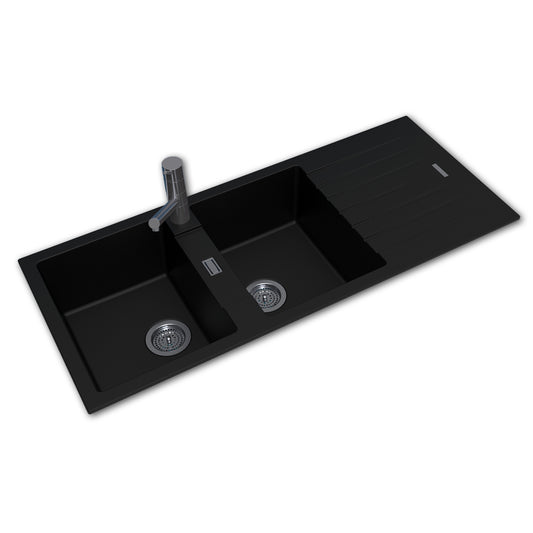
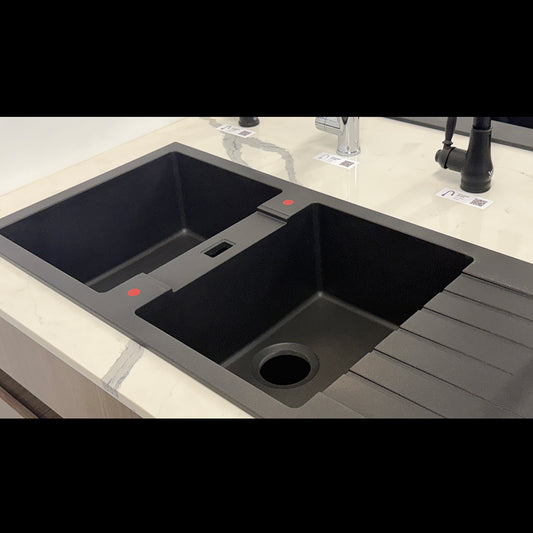
The current Komodo farmhouse model measures 580 × 490 × 221 mm and comes in beige, grey, white and black. That broader colour range is one of its main attractions. Black can create a bold contrast against a pale benchtop, while grey or beige can sit more quietly alongside timber and warm neutral cabinetry.
For care, Laveo advises against abrasive or caustic cleaning agents. Strongly coloured foods and liquids should be removed rather than left sitting on the surface, and maintenance products should be suitable for granite sinks. It is worth keeping the supplied care guide, advice for one sink material or brand may not be suitable for another.

Which one is easier to keep clean?
For most households, both can be easy enough to live with when they are cleaned regularly. Fireclay has a smooth glazed surface that is simple to wipe. Granite-stone has a more stone-like character, but it also benefits from prompt rinsing and the right maintenance product. What you notice day to day will depend as much on the colour, your local water and your cleaning habits as it does on the material.
| Care question | Fine fireclay | Laveo granite-stone |
|---|---|---|
| Routine cleaning | Use the product's approved gentle cleaning method and a soft cloth or sponge | Follow Laveo's granite-sink instructions and use suitable maintenance products |
| Avoid | Abrasive pads, unsuitable chemicals, sharp objects and severe impacts | Abrasive or caustic agents, harsh chemicals and leaving strongly coloured foods or liquids on the surface |
| After use | Rinse away residue and dry if water spotting is noticeable | Remove residue promptly, rinse and use the manufacturer-recommended maintenance routine |
| Stubborn marks | Use only a cleaner approved for the fireclay glaze | Use Laveo's model-specific guidance; do not assume a fireclay cleaner is suitable |
A practical tip: no sink colour hides everything. Black can highlight pale mineral or soap residue, while white can make dark food residue and metal transfer easier to spot. Think about the marks you commonly see in your kitchen rather than choosing a colour on that promise alone.
Can fireclay or granite-stone sinks scratch, stain or chip?
They can, but that does not mean either is unusually fragile. A better way to think about it is that both are durable kitchen materials with different vulnerabilities, and sensible care helps reduce the risk.
Fireclay
A properly made fireclay sink is designed for kitchen use, and its fired glaze resists everyday staining and wear. However, it is a rigid material. A severe blow from heavy cookware can chip or crack the surface, while abrasive cleaning can scratch or dull the glaze. Metal marks can also appear on a light surface.
Granite-stone
A granite-stone sink is also designed as a working kitchen surface, but it is not permission to use knives, scouring products or caustic cleaners on it. Laveo advises against abrasive and caustic agents and recommends not leaving substances such as beetroot, wine or lemon juice on the surface. Follow the supplied care and warranty information rather than relying on a generic “granite sinks cannot stain” claim.
A bottom grid or protective mat may reduce direct contact from heavy cookware if it is compatible with the bowl, but it does not replace correct cleaning and handling. Remove and clean beneath accessories so residue does not remain trapped.
Which material is heavier?
There is no reliable “this material is always heavier” rule. Fireclay and granite-stone farmhouse sinks are both substantial, and weight changes with the sink's size, wall thickness and bowl configuration. A large double-bowl fireclay sink may outweigh a compact granite-stone model, but another pair of sinks could compare differently.
If the product weight is not listed, ask for it before the cabinet is built. Your cabinetmaker can then plan support for that exact model and its installation. A farmhouse sink should not simply be expected to hang from sealant or rely on the benchtop alone.
For the complete measuring and trade-coordination process, read Farmhouse Sink Cabinet Requirements: What to Check Before Ordering.
Do both materials require cabinet support?
Both require the installation and support method specified for the exact model. Farmhouse sinks occupy the front of the sink cabinet and commonly need a purpose-built shelf, frame or other support beneath the bowl. Cabinet dimensions, apron cut-out, benchtop reveal and plumbing clearances must be planned at the same time.
Have the physical sink available before final cabinet and benchtop fabrication, especially when the product instructions mention manufacturing tolerances. A nominal 580, 610, 762 or 838 mm sink width does not confirm the minimum cabinet size.
Is white or black more practical?
That depends on what you would rather see, and clean. White gives you the bright, familiar farmhouse look and makes food residue easy to notice, but it may also show dark marks or metal transfer. Black creates beautiful contrast and works naturally with dark mixers or appliances, although pale limescale, soap residue and dried droplets can stand out.
Grey and beige are useful middle-ground choices if you prefer a softer, tonal kitchen. Whichever colour catches your eye, try to view the actual finish where possible. Photography, screen settings and room lighting can make a sink look warmer, cooler, glossier or more matte than it does in person.

Which one suits your kitchen style?
Fine fireclay is an easy starting point for a traditional white butler-sink look, especially alongside Shaker cabinetry, timber details or a Hamptons-inspired palette. Yet it does not have to feel old-fashioned. A simple apron, clean cabinetry and streamlined tapware can make white fireclay feel very contemporary.
Granite-stone becomes especially appealing when colour is part of the design. Black creates a graphic focal point, grey works well with concrete and cool-toned finishes, beige softens warm neutral schemes, and white keeps the room light while offering a different surface character from glazed fireclay.
Remember that the sink is only one part of the picture. The apron profile, mixer, benchtop, cabinet doors, handles and lighting all help decide whether the finished kitchen feels traditional, transitional or modern.
Does the sink include a waste or overflow?
Check the individual product page, and do not make a collection-wide assumption. Ezymall's current 580 × 490 mm Laveo Komodo granite-stone farmhouse products contains overflow and a silver strainer and fittings in their package contents. That does not mean every farmhouse sink includes the same waste, overflow or plumbing components.
For any model, confirm:
- the waste-outlet size;
- whether a strainer waste is included;
- whether the sink has an overflow;
- whether the overflow and waste components are compatible;
- what trap or space-saving siphon is supplied, if any; and
- that the cabinet has room for the waste, trap and other services.
What about a stainless-steel farmhouse sink?
Stainless steel is a legitimate third option in the wider market. It is often lighter than a similarly sized fireclay farmhouse sink and is not vulnerable to glaze chipping, but it can scratch, develop water spots, dent under sufficient impact and produce a different sound and visual effect. Gauge, construction, finish and sound-deadening treatment vary by model.
Ezymall's current farmhouse collection contains fine-fireclay and granite-stone models; but does not include any stainless-steel farmhouse sink. If you prioritise stainless steel, you may explore Ezymall's broader stainless-steel kitchen sink collection.
A simple way to make your decision
| If this matters most | Start by considering | Then verify |
|---|---|---|
| Classic white glazed appearance | Fine fireclay | Size, bowl layout, care guide and cabinet support |
| Black, grey, beige or stone-like colour | Granite-stone | Actual finish, maintenance directions and included components |
| Large cookware | A suitable single bowl in either material | Internal bowl dimensions—not external width alone |
| Separate washing and rinsing zones | A double-bowl fireclay model in Ezymall's current range | Individual bowl dimensions, waste positions and cabinet size |
| Simplest renovation fit | Whichever exact model suits the cabinet and benchtop | Technical drawing, actual sink, trades and support plan before ordering |
If bowl size is the deciding factor, compare internal dimensions using our Australian kitchen sink size guide. A wider external sink does not always provide the bowl arrangement you expect.
Frequently asked questions
Is fireclay better than granite-stone for a farmhouse sink?
Neither is universally better. Fireclay suits customers who prefer a smooth glazed surface and traditional white farmhouse character. Granite-stone suits customers who want a stone-like appearance and more colour options. Compare the exact model's size, weight, care guide, support requirements and inclusions.
Are granite-stone farmhouse sinks made from solid natural granite?
Do not assume so. Ezymall uses the verified product term “granite-stone” for its current Laveo Komodo models, but the product's exact material formulation should come from manufacturer documentation. It should not be described as carved solid granite or assigned a stone percentage without evidence.
Do white fireclay sinks stain?
The glazed surface is designed to resist everyday staining, but residue and marks can still appear and unsuitable cleaners can damage the finish. Rinse spills promptly and follow the care instructions for the exact sink rather than describing it as stain-proof.
Do black granite-stone sinks show water marks?
They can. Pale mineral deposits, soap residue and dried droplets may contrast with a dark surface, particularly in hard-water areas. Regular cleaning and the manufacturer-approved maintenance method can reduce build-up.
Can a fireclay farmhouse sink chip?
Yes. Fireclay is durable but rigid, and a severe impact from heavy cookware can chip or crack the glaze or body. Avoid dropping heavy objects and do not use abrasive tools or cleaners that are not approved for the product.
Which farmhouse sink is lighter?
Compare the published weight of the exact models. Material alone is not enough because sink width, wall thickness and single- or double-bowl construction affect weight. Both fine fireclay and granite-stone farmhouse sinks may need substantial cabinet support.
Do farmhouse sinks come with a waste and overflow?
Inclusions vary. Some sinks include a strainer waste or fittings and some do not. An overflow is also model-specific. Check the product specifications, package contents and plumbing compatibility before ordering.
So, which one would feel right in your kitchen?
If your heart is set on the smooth white look of a traditional butler sink, fine fireclay will probably feel like the natural choice. If colour and a stone-like finish are more important, granite-stone gives you black, grey, beige and white options to work into the room.
Then come back to the practical details: the internal and external dimensions, bowl layout, weight, care instructions, waste and overflow, cabinet support and how the finish looks in your light. Once those boxes are ticked, you can choose with much more confidence, and enjoy the sink for how it works as well as how it looks.